Italian
 German
 French


Montepescali, the Balcony of the Maremma near Grosseto
- Category What to visit in Maremma
Why Montepescali is known as the Balcony of the Maremma
Number of views: 764Agriturismo - Where to stay overnight
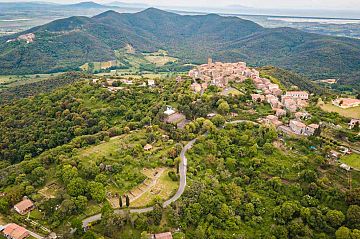
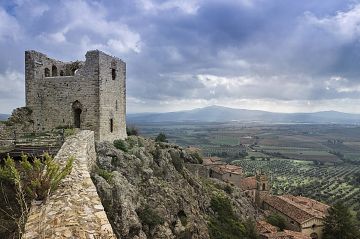
Perched on the hills north of Grosseto, Montepescali is one of those places that invite you to slow down. The village preserves narrow lanes, small squares, Romanesque churches and sections of its ancient defensive walls, but above all it offers sweeping views over the Maremma plain. This is why it is known as the “balcony” or “terrace over the Maremma”.
A village between hills, plains and sea
Montepescali stands at about 222 metres above sea level, in a position that once overlooked the shores of the ancient Lake Prile. Today, where that wide stretch of water once lay, the view opens onto fields, olive groves, country roads and, on the clearest days, the line of the coast. Its elevated position immediately explains the village’s nickname: simply look for an opening between the houses or follow a section of the outer walls to understand how deeply the panorama belongs to Montepescali’s identity.
The name of the village is also traditionally linked to fishing, an important activity when the geography of the area was very different from today. This connection with the ancient landscape adds depth to the visit: Montepescali is not only a scenic viewpoint, but also a place from which to read the centuries-old transformations of the Maremma.
What to see in Montepescali at a slow pace
The best way to discover Montepescali is on foot. The historic centre is compact and invites you to move slowly, following its stone lanes towards small squares, countryside views and buildings that reveal the role the village played over the centuries. There is no need for a fixed itinerary: here, much of the pleasure comes from gentle detours, archways and details that appear between one façade and the next.
Among the most recognisable landmarks are the old hospital and the clock tower. They help you imagine Montepescali as a small, well-organised community, still preserving traces of its civic history in its urban fabric. The castle is documented as early as the 11th century, and the village became a free commune in 1147: two details that explain the historical depth enclosed within such a small area.
The village churches and works of art
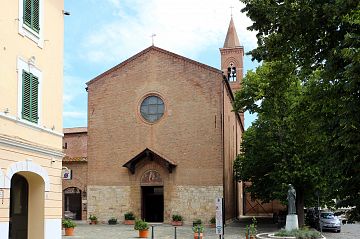
At the entrance to the village stands the Church of Santi Stefano e Lorenzo, documented from 1188 and featuring a Romanesque layout. Inside, there are references to a 14th-century fresco of the Assumption of the Virgin, linked to the Sienese school, and a stucco altar dedicated to Saint Sebastian, dating from the late 15th century. It is an early sign of how art and devotion left works of interest even in a small village.
Continuing towards the castle square, you reach the parish church of San Niccolò, a 13th-century building known for its 14th-century fresco cycle from the school of Bartolo di Fredi. The church is also associated with an altarpiece attributed to Matteo di Giovanni, depicting the Madonna enthroned with Child, angels and saints. Before visiting, it is advisable to check the actual opening times of the religious buildings and access to the artworks: in a village such as Montepescali, opening hours may be limited or depend on conservation needs.
The walls and the Fortilizio del Gauscone
One of the most atmospheric parts of the visit follows the village walls. The fortifications, interrupted by square towers, recall Montepescali’s defensive role and still define its profile today. The most imposing structure is known as the Fortilizio del Gauscone. Observing the walls from the outside helps you better appreciate the relationship between the settlement and the countryside: on one side, the compact cluster of houses; on the other, the openness of the plain.
This contrast is one of the reasons why Montepescali works so well as a stop during a rural stay. Within a small area, it brings together medieval architecture, agricultural landscape and local memory, offering an experience that feels different from both the seaside resorts and the centre of Grosseto.
The Ildebrando Imberciadori Museum of Local History
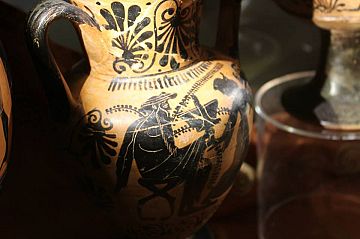
To learn more about the history of the village, you may consider visiting the “Ildebrando Imberciadori” Museum of Local History. Its collections include documents from different periods, archaeological finds, tools connected to rural life and objects that tell the story of local customs and community traditions. It is a valuable complement to a walk through the village, as it links the buildings and streets to the people who once lived there.
The museum is indicated as open on request for small groups. It is therefore best to enquire and make contact before planning your visit, rather than considering it a stop that is always accessible without prior arrangement.
The rural landscape around the village
The charm of Montepescali continues beyond the walls. The village is surrounded by a landscape shaped over time by agricultural work: olive trees, fields and Mediterranean scrub guide the eye towards the plain. It is precisely this continuity between the built village and the countryside that makes the visit so fitting during a farm stay. After seeing churches and fortifications, the panorama helps you recognise the rural character that still defines this part of the Maremma.
The light can change the whole experience. In the morning, the outlines of the plain appear sharper; in the afternoon, the warm tones of stone and countryside take centre stage. Photography lovers can look for viewpoints along the edge of the village, while respecting private property and community spaces. There is no need for spectacular effects: the most interesting images come from the proportions of the landscape, the quiet atmosphere and the layering of houses, walls and horizon.
How to include Montepescali in a stay in the Maremma
Montepescali is ideal for those who enjoy uncrowded villages, landscape photography and short walks combining art and history. It can be visited as a destination in its own right or paired with Grosseto and other places on the plain. Those wishing to extend the experience into nature may also consider the surrounding woods and the route towards the monastery of Santa Maria Maddalena, checking the trail and conditions in advance.
To truly appreciate the village, it is best to take your time: enjoy the view, enter the churches when they are open, follow the walls and pause in the small squares. Before setting off, it is useful to check opening times, accessibility and local road conditions through official tourist channels. These simple precautions are especially important in villages where monuments and museums may have variable visiting arrangements.
A Maremma to admire from above
Montepescali does not try to impress with major attractions: it wins you over through the compact charm of the village, its stone architecture, its works of art and the horizon opening out across the plain. It is an ideal destination for adding a slow, authentic moment to your journey. By choosing a farm stay in the Maremma as your base, you can alternate visits to villages with days dedicated to the countryside, the sea and the many experiences this area has to offer.